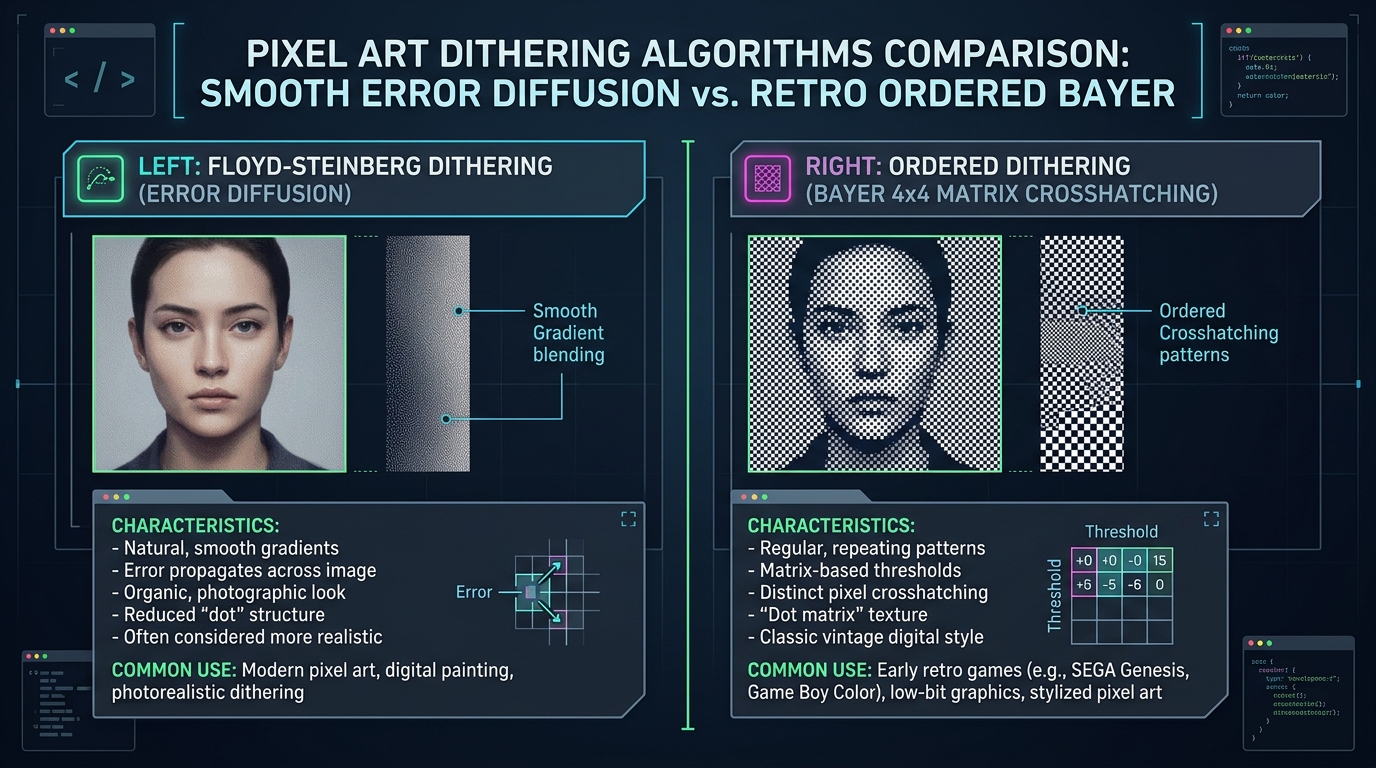
Dithering is one of the most brilliant algorithmic triumphs in the history of computer science. Born from the harsh physical memory constraints of 1970s and 80s framebuffers, dithering exploits the human eye’s spatial blending to trick our brains into seeing thousands of smooth shades from a palette of only four or eight colors.
In modern pixel art and retro game development, choosing between Floyd-Steinberg Error Diffusion and Bayer Ordered Dithering fundamentally defines the visual identity of your project. In this technical guide, we will analyze the mathematics, visual artifacts, and practical applications of both algorithms.
What is Dithering in Computer Graphics and Pixel Art?
When you reduce an image from 24-bit TrueColor (16.7 million colors) down to a 4-color Game Boy or 16-color CGA palette, each pixel must be rounded to its closest palette neighbor. This rounding creates quantization error:
Error = OriginalColor - QuantizedColor
Without dithering, quantization error is simply discarded, resulting in severe color banding harsh, unnatural stair-step transitions across gradients like skies and skin. Dithering preserves this lost energy by distributing the error across neighboring pixels or modulating thresholds across a grid.
Floyd-Steinberg Error Diffusion: Math & Mechanics
Published in 1976 by Robert W. Floyd and Louis Steinberg, this algorithm revolutionized digital printing and graphics. As the algorithm scans through an image pixel-by-pixel, it calculates the color difference between the original pixel and its nearest palette color, then diffuses that leftover error to four neighboring pixels that have not yet been evaluated:
| Relative Pixel Position | Fraction of Error | Percentage |
|---|---|---|
Right (x + 1, y) |
7 / 16 |
43.75% |
Down-Left (x - 1, y + 1) |
3 / 16 |
18.75% |
Directly Down (x, y + 1) |
5 / 16 |
31.25% |
Down-Right (x + 1, y + 1) |
1 / 16 |
6.25% |
Because the error fractions sum to exactly 16/16 = 1.0, no luminance energy is lost. The overall average brightness of the image is preserved with pinpoint accuracy. This makes Floyd-Steinberg the undisputed champion for converting real-world photographs, human portraits, and organic landscapes.
Bayer Ordered Dithering: Threshold Matrices & Crosshatching
Invented by Bryce Bayer in 1973 (the same pioneer who created the Bayer filter sensor in digital cameras), ordered dithering operates completely independently of neighboring pixel calculations. Instead of diffusing error, it modulates pixel luminance against a repeating mathematical threshold matrix.
The standard 4×4 Bayer matrix normalizes values from 0 to 15:
M4 = [
  [  0,  8,  2, 10 ],
  [ 12,  4, 14,  6 ],
  [  3, 11,  1,  9 ],
  [ 15,  7, 13,  5 ]
] * (1 / 16)
Because the matrix coordinates (x % 4, y % 4) determine the threshold, Bayer dithering produces unmistakable checkerboards, crosshatch diamonds, and herringbone textures. This is the exact signature look of the original 1989 Nintendo Game Boy, 1984 Apple Macintosh System 1, and Sega Genesis FMV cutscenes.
Head-to-Head Comparison: Visual Strengths & Weaknesses
| Metric | Floyd-Steinberg (Error Diffusion) | Bayer Matrix (Ordered Dithering) |
|---|---|---|
| Visual Texture | Organic, stippled, painterly | Geometric, crosshatched, structured |
| Photographic Quality | Superior (Natural facial shading) | Stylized (Noticeable grid patterns) |
| Hardware Era | Early PC scanners, desktop publishing | Game Boy, Mac Classic, Sega Genesis, Amiga |
| Parallelization | Slow (Requires sequential row scanning) | Ultra-Fast (Computed in parallel on GPU/Shader) |
| Common Artifacts | "Worms" (snaking trails across flat areas) | Repetitive crosshatch bands |
The Decision Matrix: When to Choose Floyd-Steinberg vs Bayer
- Choose Floyd-Steinberg when: You are converting a real photograph of a person, pet, or landscape. The continuous error diffusion guarantees smooth cheekbones, realistic hair gradients, and soft lighting falloff. Try it live in our Photo to Pixel Art Converter.
- Choose Bayer Matrix when: You want an authentic 1980s or 1990s retro video game aesthetic. The distinctive crosshatch pattern gives flat character sprites and UI screens instant hardware nostalgia.
- Choose None (Solid Quantization) when: You are designing Perler bead patterns, cross-stitch grids, or clean vector pixel icons where every pixel must be a solid, isolated block.
Frequently Asked Questions (FAQ)
Why do pixel artists use dithering?
Dithering creates the optical illusion of new colors, smooth gradients, and surface textures using a very limited palette (such as 4, 8, or 16 colors) by interleaving colored pixels in strategic patterns.
What is the main difference between Floyd-Steinberg and Bayer dithering?
Floyd-Steinberg is an error diffusion algorithm that pushes quantization rounding errors into neighboring pixels, resulting in organic, photographic gradients. Bayer dithering is an ordered threshold algorithm that applies a fixed mathematical matrix, creating regular crosshatch patterns reminiscent of retro consoles like the Game Boy and Sega Genesis.
What causes "worm artifacts" in Floyd-Steinberg dithering?
When error diffusion scans rows linearly, rounding errors can align into wavy, snaking lines called worms. High-quality implementations (like Pixelify) use serpentine scanning (alternating left-to-right and right-to-left) to disperse artifacts evenly.
Is dithering still relevant in modern games?
Yes! Beyond retro indie games (like Return of the Obra Dinn and Papers, Please), dithering is widely used in modern 3D rendering engines (Unreal Engine 5, Unity) for screen-door transparency, shadow mapping, and preventing 8-bit color banding.