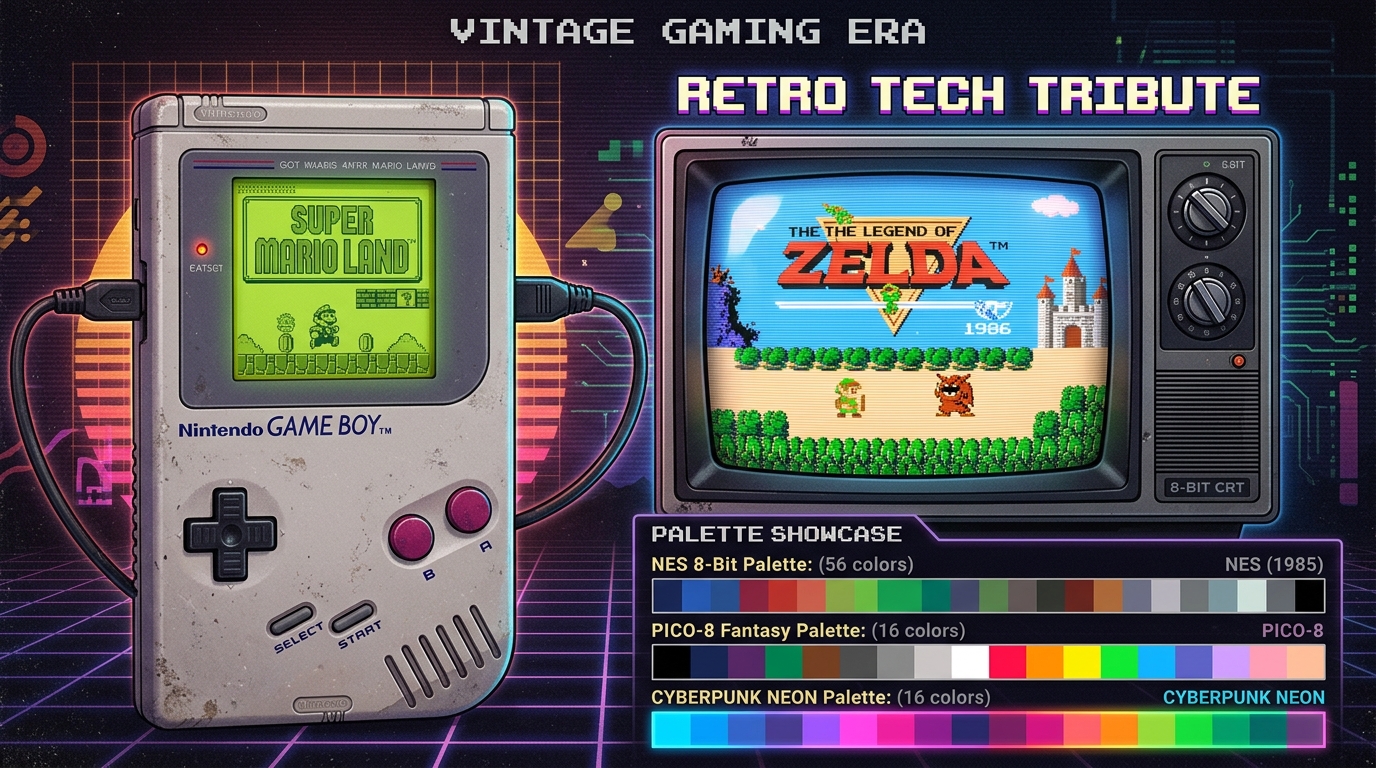
In modern digital art, creators have access to 16.7 million colors with a single click. Yet paradoxical as it may seem, some of the most emotionally resonant, unforgettable visual masterpieces in digital history were created under brutal hardware limits of 4, 16, or 25 colors.
When hardware engineers designed the video chips of the 1980s, every single bit of display memory was astronomically expensive. Color palettes weren't chosen by artistic committee they were dictated by silicon transistor budgets. In this deep dive, we explore the history, hex values, and color harmony secrets of the four most iconic retro gaming palettes of all time.
Why Color Palettes Defined Vintage Gaming Eras
In vintage console hardware, color served as functional communication. Because sprites were tiny (often only 8×8 or 16×16 pixels), distinct luminance steps were required to separate characters from backgrounds, signal interactive items, and indicate enemy damage states.
1. Nintendo Game Boy DMG-01 (4 Shades of Green)
Released in 1989, Gunpei Yokoi’s Game Boy became an international sensation. Its unbacklit reflective LCD displayed 2-bit color depth (4 values):
| Shade | Hex Code | Luminance | Typical Game Usage |
|---|---|---|---|
| Shade 0 | #9bbc0f |
85% | Bright sky, backgrounds, highlights |
| Shade 1 | #8bac0f |
65% | Midtone terrain, skin, secondary accents |
| Shade 2 | #306230 |
35% | Shadows, character outlines, brick detail |
| Shade 3 | #0f380f |
15% | Deep blacks, eyes, UI text, foreground silhouettes |
2. Nintendo NES / Famicom (54-Color PPU Architecture)
The Nintendo Entertainment System’s Ricoh 2C02 PPU generated colors directly through composite NTSC video signals. Unlike RGB systems, the NES generated colors by modulating phase angles relative to the colorburst reference signal.
Its 54 available colors are famous for rich earth tones, brick reds (#b81e00), cobalt blues (#003888), and vivid greens. Because each 8×8 sprite could only use 3 colors plus transparency, characters like Mario were designed with blue overalls and red shirts so they wouldn't disappear against green backgrounds.
3. PICO-8 Fantasy Console (16-Color Masterpiece)
Created in 2015 by Joseph White, PICO-8 simulated a fictional 1980s console that never was. Its 16 colors are regarded by game artists as one of the most versatile palettes ever compiled:
#000000 Black,#1D2B53 Dark Blue,#7E2553 Dark Purple,#008751 Dark Green#AB5236 Brown,#5F574F Dark Grey,#C2C3C7 Light Grey,#FFF1E8 White#FF004D Red,#FFA300 Orange,#FFEC27 Yellow,#00E436 Green#29ADFF Blue,#83769C Indigo,#FF77A8 Pink,#FFCCAA Peach
4. IBM CGA Mode 1 (Cyan, Magenta, White & Black)
In 1981, IBM released the Color Graphics Adapter. In 320×200 mode, users had access to Palette 1 High Intensity: Black, Cyan (#55ffff), Magenta (#ff55ff), and Bright White (#ffffff).
While initially criticized for its garish look in historical simulations, the high-contrast contrast of hot neon magenta and luminous cyan became the foundational visual DNA of modern Synthwave, Outrun, and Cyberpunk aesthetics.
How to Apply Retro Palettes to Modern Photos in Pixelify
In the Pixel Art Generator, you can select any of these legendary historical palettes. Our engine quantizes your modern camera photo into the exact mathematical color space of the vintage console in real time, accompanied by optional CRT scanlines and chromatic split effects.
Frequently Asked Questions (FAQ)
Why did the original Game Boy have green screens instead of black and white?
The 1989 Nintendo Game Boy used a reflective STN (Super-Twisted Nematic) LCD screen without a backlight to maximize battery life (giving 30+ hours on 4 AA batteries). The natural polarization of the liquid crystal layer produced olive-green hues rather than pure monochrome.
What are the exact hex codes for the original Game Boy palette?
The definitive 4-shade Game Boy DMG hex codes are: #0f380f (Darkest Olive), #306230 (Dark Olive), #8bac0f (Light Olive), and #9bbc0f (Brightest Green-Yellow).
How many colors could the NES display at once?
While the NES Picture Processing Unit (PPU) had a hardware master palette of 54 colors, hardware limitations allowed a maximum of 25 colors on screen at any given frame: 1 background color, four 3-color background tile palettes, and four 3-color sprite palettes.
What is the PICO-8 palette?
PICO-8 is a virtual fantasy console created by Joseph White (Lexaloffle). It features a hand-tuned 16-color palette engineered specifically to have high aesthetic harmony across all primary colors, warm ramps, and cool shadow tones.